
The Myth of Consistency: What It Actually Means to Build a Writing Practice with ADHD
Here's something I hear from almost every ADHD writer I work with, usually within the first few minutes of our first session together:
"I know I should write every day. I just can't make myself do it."
Without exception, those wicked stepsisters—guilt and shame—live just beneath that statement. That quiet voice insisting you're to blame accumulates every day you don't write. Eventually, this self-blame grows to the point where it makes opening your manuscript feel like walking into a room where everyone is disappointed in you.
I want to talk about where that guilt and shame come from, why they’re misdirected, and what a writing practice that actually fits your brain looks like instead.
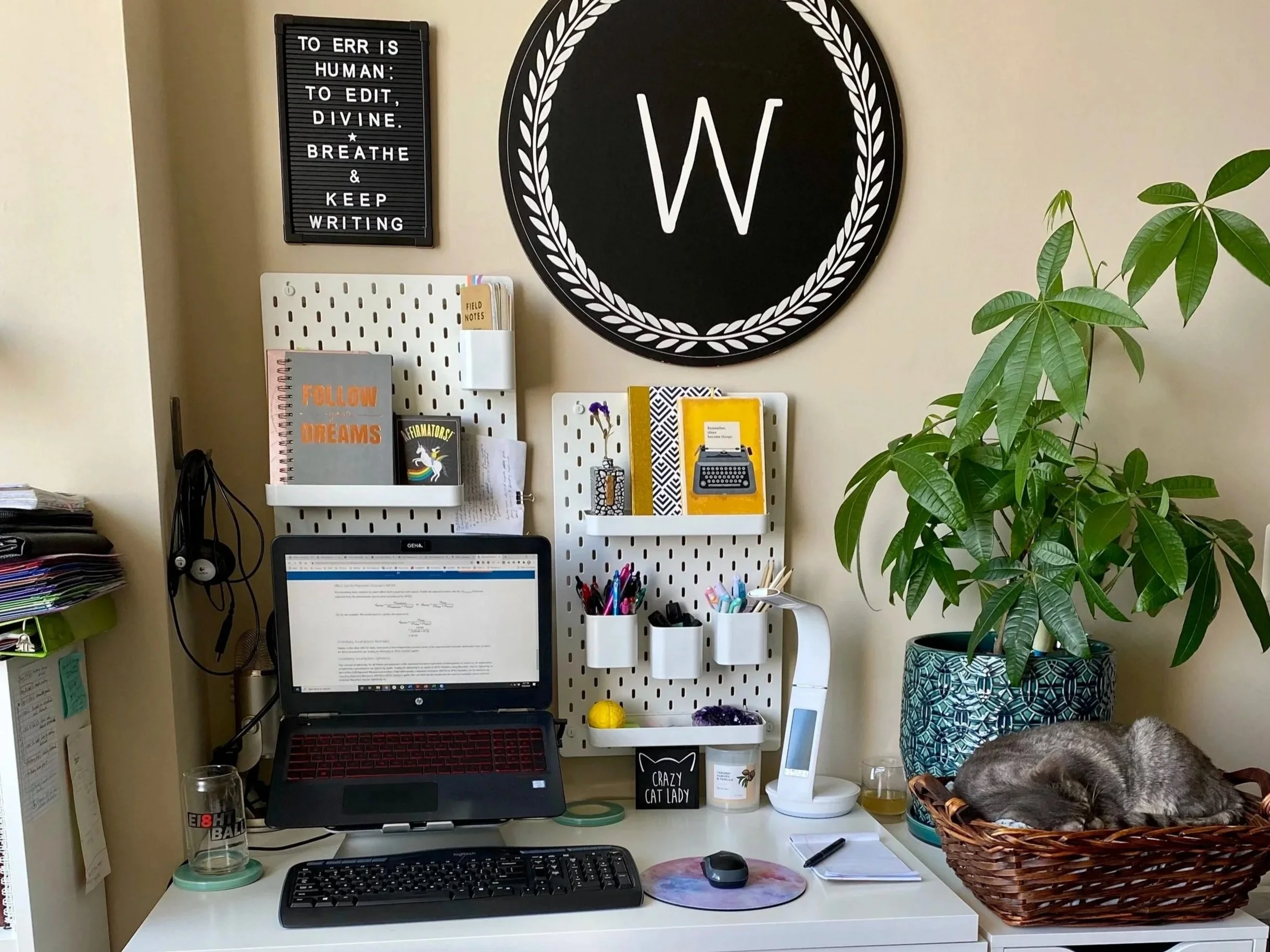
My desk setup while I was in the midst of writing my PhD dissertation. No desk is complete without a sleeping creature (in this case, a cat).
The "Write Every Day" Rule Wasn't Made for Your Brain
The advice is everywhere. In craft books, MFA programs, social media, your favorite author's interview. Write every day. No excuses. Real writers are consistent.
It sounds like discipline, but it's actually a prescription written for a neurotypical nervous system.
ADHD brains don't run on discipline and repetition the way that advice assumes. Our motivation system is interest-based. It runs on novelty, personal interest, engaging challenges, and urgency. Not on "it's 9am and this is what I do now." When those conditions aren't present, the brain begins to actively resist doing the task, even if it’s something you had no problem doing yesterday. That resistance is neurological, not laziness. And knowing this gives you the upper-hand when it comes to figuring out what works for you, not what everyone else assumes will work.
As a late-diagnosed ADHDer with a PhD in cognitive-behavioral neuroscience, I've spent years studying exactly how attention and motivation mechanisms work differently in different brains. The research is unambiguous: executive functioning deficits found in ADHD brains make task initiation genuinely harder. The cultural myth that real writers write every day is not only unhelpful for ADHD writers, it's actively harmful, because it turns a neurological reality into a moral failing.
You are not undisciplined. You are using a model that was never designed for you.
What Sustainable Consistency Actually Looks Like
The goal of a writing practice isn't to write every day. It's to keep coming back to your writing even after life, burnout, hyperfocus on something else, or a rough ADHD week gets in the way.
I call this brain-friendly consistency: showing up in ways that work with your energy and cognitive patterns, not against them. It looks different for every writer, but here are three versions that work most often:
Flexible consistency: You write three days a week instead of seven, but you choose those days intentionally, based on your real schedule and energy patterns rather than an idealized calendar.
Contextual consistency: You anchor writing to an existing cue in your day, like after your morning coffee, before your evening wind-down, on your lunch break. Habit stacking works with the ADHD brain because it reduces the decision fatigue of getting started and leverages behavior that's already automatic.
Seasonal consistency: You lean into creative bursts when they come, and use slower stretches for planning, research, or reflection. Both phases count. Both move your project forward.
Personally, I write in seasons. There are stretches where words come almost every day. Then, there are slower weeks where I'm mapping structure or letting ideas settle. Neither is failure. Both are part of my writing practice.
“Consistency isn’t about writing every day. It’s about continuing to return to the work.”
The Question I Hear Most: How Do I Come Back After a Long Gap?
This is the one that comes up in almost every client conversation, and it has two distinct flavors.
1. The fear of taking breaks.
Some ADHD writers are so afraid of losing their narrative thread (voice, momentum, sense of where the story is going) that they push through when their body and/or brain want them to rest. They write through burnout, through illness, through life chaos, because stopping feels like losing everything. And then they crash harder than if they had just taken the break.
If this is you, here's the reframe: the narrative thread doesn't only live in your head. It lives in the work itself, and you can leave yourself a map back to it. At the end of every writing session, before you close the document, write yourself one or two sentences: where you are, what just happened, what comes next. That's it. Some writers also keep a running scene-by-scene summary in the order they plan for the book, so they can re-orient quickly no matter how long they've been away.
You don't have to hold the whole story in your head. You just have to leave the door unlocked, so you can re-enter without needing to break in (or break down).
2. The struggle to come back after life happened. (Because it will.)
The other version is more common: you didn't choose to step away. Life happened, whether it be an illness, a move, a hard season, a job change, a kid, a mental health dip. The writing stopped, and now weeks or months have passed and the manuscript feels like a stranger.
What keeps writers from coming back isn't usually lack of desire. It's task initiation—the ADHD brain's difficulty starting something that doesn't offer immediate reward—combined with guilt and sometimes a quiet fear: What if I can't find the flow again? What if I've lost it?
You haven't lost it. But guilt makes the gap feel wider than it is, and the wider it feels, the harder it is to step back over.
The way back is smaller than you think. It’s not forcing a full writing session or anxiously catching up on everything you missed. It’s simply opening the document you were working on before the interruption. Reading what you wrote last. Leaving yourself one note about what comes next. That's a complete return. Everything else builds from there.
Your Minimum Viable Writing Practice
The most useful question isn't "What's my ideal writing schedule?" It's: What's the smallest version of a writing practice I can maintain on my worst days and still feel like I showed up?
That's your Minimum Viable Writing Practice: the floor, not the ceiling. On a low-energy, high-chaos, everything-is-hard day, what can you actually do and still feel like you’ve accomplished something?
Maybe it's opening your manuscript and reading the last paragraph you wrote. Maybe it's dropping a scene idea into your notes app. Maybe it's writing one new sentence.
The goal isn't output, it's self-trust. Rebuilding the belief that you can return to your writing without having to earn your way back in, without owing penance for the time away.
A Mindset Shift Worth Making
Most ADHD writers I work with are asking the wrong question when they get stuck. They're asking: Why can't I stay consistent?
That question keeps your attention on what's broken. It tends to spiral into identity-level conclusions, like I'm not a real writer, I'll never finish this, I don't have what it takes. Those creeping thoughts have nothing to do with reality and everything to do with a shame loop that ADHD brains are particularly vulnerable to.
Try this instead: What helped me write today and how can I do more of that?
That question is generative. It gives you data you can actually use. It points toward what's working rather than cataloguing what isn't.
And when you can't answer it because you didn't write today? That's okay too. The question will be there tomorrow.
Frequently Asked Questions from ADHD Writers
Is it bad if I don't write every day?
No. For many ADHD writers, daily writing is actively counterproductive. It creates pressure that triggers avoidance and shame rather than momentum. What matters is that you keep returning to the work. Frequency matters less than continuity.
How do I stop feeling guilty about taking a break from my writing?
Start by recognizing that the guilt itself is part of what's keeping you away. The longer you stay out of the manuscript because returning feels too loaded, the harder it gets. Shrink the re-entry: open the document, read one page, close it. That's enough. Guilt loses power when you stop feeding it with avoidance.
What if I've been away from my manuscript for months and I've completely lost the thread?
Read what you have. Don't judge it, just read it like a reader meeting the story for the first time. Take notes as you go: what's working, what you remember wanting to do, where the energy is. You'll find the thread. It didn't go anywhere. And going forward, end every session with a one or two sentence note to your future self about where you are and what comes next.
How do I know if I need a writing practice overhaul vs. just getting back on track?
If you've tried to return to the work multiple times and keep hitting the same wall—avoidance, paralysis, a sense that something structural isn't working—that's usually a sign the approach needs to change, not just your effort level. That's exactly what coaching is for.
Can ADHD writers actually finish books?
Yes. Absolutely yes. And many ADHD writers have. The writers with ADHD who finish their books aren't more disciplined or more talented. They've built a writing practice that accounts for how their brain actually works. One that includes external accountability, flexible structure, and enough self-compassion to keep coming back after the hard days.
The Heart of It
If your writing life looks like a series of restarts—a burst of pages, then a gap, then picking up again—that’s not failure. That's evidence you still care enough to return. The restarts are the practice.
You don't need to become more consistent to be a writer. You need a writing practice that forgives you when life happens, and makes it easy to come back without shame.
Questions for You, Dear Reader
What would your writing practice look like if it didn't have to be perfect?
What could you accomplish if you built a writing practice that worked with your brain, instead of against it?
About the Author
Dr. Candice Wiswell is an ADHD writing coach, developmental editor, and fiction writer with a PhD in Psychology and a concentration in cognitive-behavioral neuroscience. She helps neurodivergent writers move from paralysis to momentum, so they can finally write their book, build their business, or both.
Ready to build a writing practice that actually fits your brain? Book your free 20-minute consult and let's figure out what's getting in your way.
—> Also on the blog: Why ADHD Writers Can't Finish Their Book (And What Actually Helps)